March 26: More Istanbul
Hagia Sophia
Previous | March 26 Index | Next | Eclipse
Home
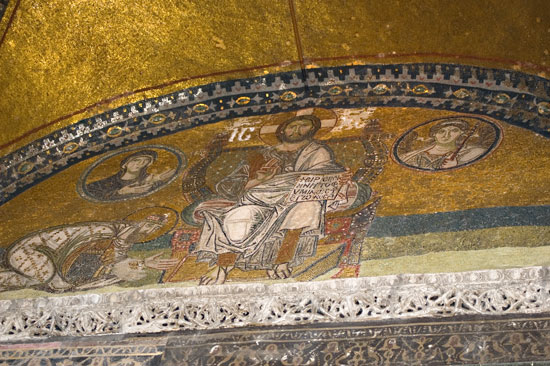
Hagia Sophia is one of the greatest surviving examples of Byzantine architecture. Of great artistic value was its decorated interior with mosaics and marble pillars and coverings. The temple itself was so richly and artistically decorated that Justinian is said to have proclaimed "Solomon, I have surpassed thee!" Justinian himself had overseen the completion of the greatest cathedral ever built up to that time, and it was to remain the largest cathedral for 1,000 years up until the completion of the cathedral in Seville. It is today the fourth largest cathedral in the world (by size, not height)
Justinian's basilica was at once the culminating architectural achievement of late antiquity and the first masterpiece of Byzantine architecture. Its influence, both architecturally and liturgically, was widespread and enduring in the Eastern Orthodox, Roman Catholic, and Muslim worlds alike.
The dome of the Hagia Sophia has spurred particular interest for many art historians and architects because of the innovative way the original architects envisioned the dome. The dome is supported by pendentives which had never been used before the building of this structure. The pendentive enables the round dome to transition gracefully into the square shape of the piers below. The pendentives not only achieve a pleasing aesthetic quality, but they also restrain the lateral forces of the dome and allow the weight of the dome to flow downward. Although this design stabilizes the dome and the surrounding walls and arches, the actual construction of the walls of the Hagia Sophia weakened the overall structure. The bricklayers used more mortar than brick, which, of course, constitutes a weak wall. The structure would have been more stable had the builders at least let the mortar dry before they began the next layer, however, they did not do this. When the dome was placed atop the building, the weight of the dome caused the walls to lean outward because of the wet mortar underneath. When Isidorus the Younger rebuilt the original dome, he had to first build up the interior of the walls so that they were vertical in order to support the weight of the new dome. Another probable change in the design of the dome when it was rebuilt was the actual height of the dome. Isidorus the Younger raised the height of the dome by approximately twenty feet so that the lateral forces would not be as strong and the weight of the dome would flow more easily down the walls.
A second interesting fact about the original structure of the dome was how the architects were able to place forty windows around the base of the dome. The Hagia Sophia is famous for the mystical quality of light that reflects everywhere in the interior of the nave, which gives the dome the appearance of hovering above the nave. This design is possible because the dome is shaped like a scalloped shell or the inside of an umbrella with ribs that extend from the top of the dome down to the base. These ribs allow the weight of the dome to flow between the windows, down the pendentives, and ultimately to the foundation.
The anomalies in the design of the Hagia Sophia show how this structure is one of the most advanced and ambitious monuments since the fall of Rome.