March 26: More Istanbul
Hagia Sophia
Previous | March 26 Index | Next | Eclipse
Home
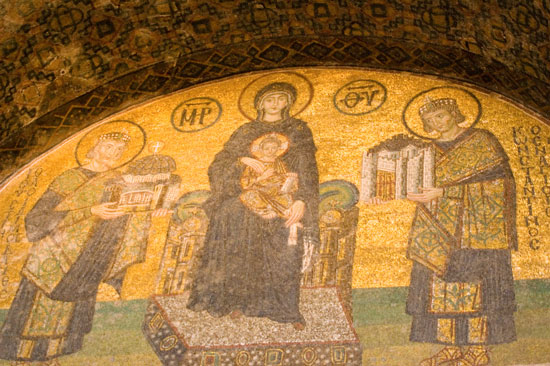
Hagia Sophia was the seat of the Orthodox patriarch of Constantinople and a principal setting for imperial ceremonies. During the Latin Occupation (1204-1261) the church became a Roman Catholic cathedral, and its many treasures and relics were dispersed. It was converted to a mosque after the Fall of Constantinople to the Ottoman Turks under Sultan Mehmed II in 1453. Since more conservative factions of Islam consider the depiction of the human form to be blasphemous, its mosaics were covered with plaster. One must note, however, that due to the foresightedness and tolerance of the Ottoman Sultans, the plaster was periodically removed, the mosaics maintained, and replastered. For almost 500 years the principal mosque of Istanbul, Ayasofya served as model for many of the Ottoman mosques such as the Shehzade Mosque, the Suleiman Mosque, and the Rüstem Pasha Mosque. The 19th century restoration of the Fossati brothers, who also built a pulpit and the four circular medallions hanging on the walls of the nave that bear the names of Muhammad and the first caliphs, is widely deemed to have destroyed much of the original mosaics.
Restoration work in the 20th century began in 1932 by the American Byzantine Institute, when most of the figures were uncovered. In 1935, under the order of Turkish president Kemal Atatürk, Hagia Sophia was secularized and turned into the Ayasofya Museum.
Due to its long history as both a church and a mosque, a particular challenge arises in the restoration process. The Christian iconographic mosaics are being gradually uncovered. However, in order to do so, important, historic Islamic art must be destroyed. Restorers have attempted to maintain a balance between both Christian and Islamic cultures. In particular much controversy rests upon whether the Islamic calligraphy on the dome of the cathedral should be removed, in order to permit the underlying Pantocrator mosaic of Christ as Master of the World, to be exhibited (assuming the mosaic still exists).
However, work has reportedly been purposely slow on the Hagia Sophia due to its important position and symbolism within the Eastern Orthodox Church. The Ecumenical Patriarch of the Greek Orthodox Church has claimed that the Turkish Government has denied offers to provide monetary assistance for the further restoration of Hagia Sophia in order to downplay its importance. Some Orthodox and Catholic Christians have gone so far as to demand the return of Hagia Sophia to the Orthodox Christian religion as a condition of Turkey's entry into the European Union.
In 2002 Reuters reported that many mosaics and icons stored in the basement of the cathedral had been damaged by damp, giving rise to questions as to whether the Turkish authorities were best placed to preserve the monument. It was further pointed out in 2005 that the scaffolding beneath the dome of the cathedral had been placed there since 1995 without restoration of the dome being completed, again giving rise to questions as to whether such restoration work was genuine.